


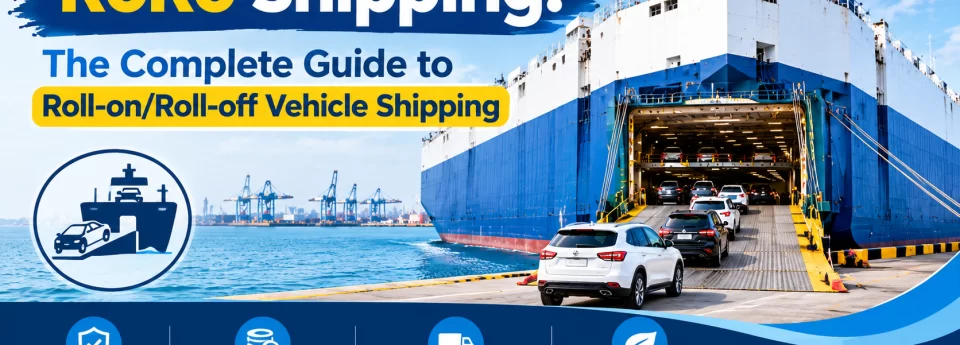
What Is a RoRo Ship? Roll-on/Roll-off Shipping Explained 2026
Quick answer: A RoRo ship (roll-on/roll-off) is a purpose-built vessel designed to carry wheeled vehicles that drive on and off under their own power via a stern or side ramp — no cranes, no containers, no lifting equipment. Cars, vans, SUVs, motorcycles, and light commercial vehicles are secured on multi-deck car decks for the voyage. RoRo is the most cost-effective international shipping method for standard running vehicles and is available from UK ports to destinations across Europe, the USA, Australia, the Middle East, Africa, and beyond.
RoRo is the method that ships the majority of the world’s new cars from factory to dealership — and it is the same technology used to ship your personal vehicle overseas. Understanding how RoRo ships work, which vehicles qualify, and how the method compares to container shipping will help you make the right choice for your shipment.
How Does a RoRo Ship Work?
A RoRo vessel is essentially a floating multi-storey car park. The key engineering feature is the stern ramp — a large, hydraulically operated ramp that lowers to the quayside at port, allowing wheeled vehicles to be driven directly aboard. Some larger vessels also have side ramps for simultaneous loading.
Once aboard, vehicles are driven to their assigned deck position by port stevedores and secured using wheel chocks and lashing straps attached to designated anchor points on the deck. The vehicle is secured from four corners and is not moved again until the vessel reaches its destination port. The ramp is raised and sealed for the voyage.
At the destination port, the process reverses — the ramp lowers, vehicles are inspected by port staff, and those cleared for release are driven off for customs processing.
Key facts about RoRo vessels:
- Multi-deck design — the largest vessels carry thousands of vehicles across 12 or more decks
- Fixed international sailing schedules, operating year-round on major routes
- Purpose-built for wheeled cargo — cars, vans, SUVs, buses, agricultural and construction equipment
- No cranes, no containers, no crane-based handling: the ramp is the only transfer mechanism
- Vehicle decks are enclosed — vehicles are sheltered from weather during transit on most vessels
What Vehicles Can Be Shipped by RoRo?
RoRo shipping is available for wheeled vehicles that are in full running condition and can be driven on and off the vessel under their own power. Vehicles that cannot do this must use container shipping instead.
- Cars and hatchbacks
- SUVs and 4x4s
- Vans and light commercial vehicles
- Motorcycles and scooters, secured upright on deck using purpose-built tie-down systems
- Caravans and trailers, provided the towing vehicle is capable or the trailer is road-legal
- Small boats on road-registered trailers
- Agricultural and construction machinery that is self-propelled and road-legal
Vehicles that cannot use RoRo:
The critical requirement for RoRo is that every vehicle must be driveable onto and off the vessel under its own power. Anything that cannot meet this condition must travel by container instead.
Non-running vehicles fall into this category automatically. If your car cannot be driven aboard, port staff have no way to load it onto a RoRo vessel — container shipping with forklift or winch loading is the only option.
Electric vehicles (EVs) are not accepted on RoRo sailings. Battery safety regulations prohibit EVs from the enclosed multi-deck car decks used on RoRo vessels. All EVs must ship by container car shipping, where specialist handling applies.
Hybrid vehicles sit in a middle ground. Many hybrids are accepted on RoRo routes, but acceptance varies by destination and sailing line. Confirmation is required at the point of booking — do not assume a hybrid qualifies without checking first.
If your vehicle is non-running, electric, or requires specialist handling, see the container car shipping page for the appropriate service.
UK Departure Ports for RoRo Shipping
ShipCars uses the following UK ports for RoRo departures, depending on route and sailing schedule:
- Southampton — major RoRo hub; serves Australasia, Americas, Middle East, Africa
- Tilbury (London Gateway) — serves Europe, Middle East, Americas, Africa
- Bristol (Portbury) — serves Americas and selected routes
- Sheerness — serves Europe
- Grimsby / Immingham — serves North Sea and European routes
Your specific port is confirmed at booking. ShipCars offers UK-wide vehicle collection by professional transporter or trade plate driver, so your departure port does not need to be local to you. Alternatively, you can deliver the vehicle directly to the departure port or to the ShipCars depot.
RoRo Transit Times by Destination
The following indicative transit times apply to RoRo sailings from UK ports. All times are approximate and subject to vessel schedules, routing, and port conditions.
| Destination | Key Arrival Ports | Approximate Transit |
|---|---|---|
| Spain / Portugal | Santander, Huelva, Cadiz | 2–10 days |
| Turkey | Gemlik, Izmir, Mersin, Derince | 10–14 days |
| USA | Baltimore, New York, Brunswick, Tacoma, Port Hueneme | 14–21 days |
| West Africa | Lagos, Tema, Abidjan, Dakar | 18 days |
| UAE / Middle East | Jebel Ali, Jeddah, Dammam, Kuwait | 18–25 days |
| East / Southern Africa | Mombasa, Dar es Salaam, Durban | 30 days |
| Australia | Fremantle, Melbourne, Sydney, Brisbane, Adelaide | 25–35 days |
For a full list of destinations and current sailing schedules, visit the ShipCars RoRo sailing schedule or contact the team directly.
The Key Advantages of RoRo Shipping
Cost-Effectiveness
RoRo is consistently the most affordable option for shipping a standard running vehicle internationally. Because the vessel is purpose-designed for high volumes of wheeled cargo, the per-vehicle cost is lower than container shipping — the vehicle occupies no container, there is no container handling equipment involved, and port turnaround is fast.
Lower Destination Port Charges
RoRo terminals typically charge lower destination handling fees than container terminals, because there is no container demurrage, equipment rental, or container inspection overhead. The vehicle drives off — the port’s job is done.
Speed and Scheduling
RoRo sailings operate on fixed schedules with high frequency on major routes. For popular lanes — Europe, USA, Middle East — sailings depart weekly or more frequently. This makes RoRo faster to schedule than container shipments, which may have less frequent departures on some routes.
Simplicity
No container inspection, no container booking, no personal effects loading process. The vehicle is driven on, secured, and driven off. For a straightforward car relocation, RoRo is the operationally simpler choice.
RoRo Shipping Rules: What Is and Is Not Permitted
Personal Belongings
Personal items are not permitted inside a vehicle on a RoRo sailing. This is not a ShipCars policy — it is a requirement of all RoRo shipping lines and reflects international maritime safety rules. RoRo vehicle decks are enclosed spaces housing thousands of vehicles; unknown contents represent fire and contamination risk that shipping lines cannot manage.
The rule in practice: vehicles are inspected at the UK port before loading. Items found inside will be removed at the owner’s cost. In some cases the vehicle may be refused loading until items are removed.
If you need to ship personal effects with your car, you must use container shipping with prior written approval from the shipping line and destination agent. For the full guide, see can I ship personal belongings with my car?
Electric Vehicles
Electric vehicles cannot be shipped by RoRo under any circumstances. Battery safety regulations prohibit EVs from multi-deck enclosed vehicle carrier decks where fire suppression access is limited. All EVs must ship by container, with an applicable hazard surcharge. Contact ShipCars for EV container shipping options.
Fuel Level
All vehicles on RoRo sailings must have their fuel level reduced to a quarter of a tank or less before loading. This is a mandatory safety requirement. Vehicles with more than a quarter tank of fuel will not be accepted for loading.
Vehicle Condition
The vehicle must be in full running condition — driveable under its own power on and off the vessel. Vehicles with flat tyres, discharged batteries, seized brakes, or mechanical faults that prevent movement under their own power cannot be loaded onto a RoRo vessel. Non-running vehicles must ship by container.
How to Prepare Your Car for a RoRo Shipment
Before your vehicle is collected or delivered to the departure port:
- Reduce fuel to a quarter tank or less — mandatory for all RoRo and container shipments
- Charge the battery fully so the vehicle can be moved at the UK port and destination
- Disable the alarm and any immobiliser — port staff must be able to move the vehicle without triggering the alarm
- Remove all personal items from the interior, boot, and glovebox — nothing may be left inside
- Photograph the vehicle from all angles before handover — your own record of pre-shipment condition
- Clean the exterior — some destinations, particularly Australia, have biosecurity requirements that may mean a dirty vehicle is held for inspection or cleaning at the importer’s cost
- Check tyre pressures and ensure the vehicle is mechanically roadworthy for port movement
- Provide two sets of keys where available
ShipCars completes an independent vehicle condition report before the vehicle leaves UK custody. This report is the baseline for any marine insurance claim.
RoRo vs Container Shipping: Which Is Right for You?
| Factor | RoRo | Container Shipping |
|---|---|---|
| Cost | Lower for standard vehicles | Higher — container cost adds to base rate |
| Destination port charges | Generally lower | Generally higher |
| Vehicle condition required | Must be fully running | Running and non-running accepted |
| Electric vehicles | Not accepted | Accepted (hazard surcharge applies) |
| Personal effects | Not permitted | Permitted in FCL containers with prior approval |
| Security / enclosure | Enclosed vehicle deck | Sealed steel container |
| Classic or high-value cars | Available but exposed to other vehicles on deck | Maximum protection in dedicated container |
| Transit time | Faster on many routes | Slightly longer on some routes |
| Best for | Standard running vehicles, straightforward relocations | EVs, non-runners, classics, personal effects, high-value |
If your vehicle is running and you are not shipping personal effects, RoRo is almost certainly the right choice for standard routes. If your vehicle is electric, non-running, high-value, or you need to include personal effects, container shipping is the appropriate method.
For a detailed comparison, see RoRo vs container car shipping — which is right for you?
The RoRo Shipping Process: What Happens Step by Step
- Get a quote: Provide your vehicle details, origin, destination, and departure date to ShipCars. A fixed, itemised quote is returned.
- Book and confirm: Accept the quote. ShipCars confirms your sailing, departure port, and the documents required.
- Vehicle collection: ShipCars collects your vehicle UK-wide, or you deliver to the depot or port.
- Condition report: A written and photographic condition report is completed before the vehicle leaves UK custody.
- UK port handling: ShipCars manages DVLA permanent export notification and UK export customs declaration. The vehicle is checked in at the RoRo terminal.
- Loading: Port stevedores drive the vehicle aboard and secure it with chocks and lashing straps.
- Transit: The vessel departs on its scheduled sailing. You receive the Bill of Lading from ShipCars shortly after departure.
- Destination arrival: The vessel discharges at the destination port. Your appointed local clearing agent manages customs clearance using the Bill of Lading and supporting documents.
- Collection: Once customs-cleared, you collect the vehicle from the destination port or arrange local delivery.
For the complete process guide, see how the car shipping process works.
Get a RoRo Car Shipping Quote
RoRo is the fastest and most cost-effective route for standard running vehicles. If your vehicle qualifies, ShipCars can confirm the next available sailing and give you a fixed price — with no hidden charges.
Call: 01495 320540 Email: info@shipcars.co.uk Get a free online quote →
Frequently Asked Questions
What is a RoRo ship?
A RoRo ship (roll-on/roll-off) is a purpose-built vessel that carries wheeled vehicles by driving them on and off via a stern or side ramp — no cranes or containers are involved. Vehicles are driven aboard by port stevedores and secured using chocks and lashing straps on multi-deck car decks for the duration of the voyage. RoRo ships range in size from coastal ferries to large ocean-going car carriers capable of carrying thousands of vehicles at once.
Can I put personal belongings in my car on a RoRo shipment?
No. Personal items are not permitted inside any vehicle on a RoRo sailing. This is a mandatory rule imposed by all RoRo shipping lines under international maritime safety requirements — it is not a ShipCars policy. Vehicles are inspected at the UK departure port before loading, and any items found inside will be removed at the owner’s cost. If you need to ship personal effects with your car, you must use container shipping with prior written approval from the shipping line and destination agent.
Are electric vehicles accepted on RoRo ships?
No. Electric vehicles cannot travel by RoRo due to battery safety regulations that apply to enclosed vehicle carrier decks. All EVs must ship by container. ShipCars offers container shipping for EVs with the applicable handling requirements. Hybrid vehicles may be accepted on some RoRo routes — confirmation is required at booking for each specific destination.
How is my car secured on a RoRo vessel?
Your vehicle is driven to its assigned deck position by a port stevedore and secured using wheel chocks placed against all four wheels and lashing straps attached to the vehicle’s manufacturer-designated lashing points. The straps are tensioned to hold the vehicle firmly in position throughout the voyage. The vehicle is not moved again until the vessel arrives at the destination port.
What happens if my car is damaged on a RoRo vessel?
If you have marine transit insurance in place, you make a claim using the pre-shipment condition report as the baseline. The condition report is completed by ShipCars before the vehicle leaves UK custody and documents the vehicle’s pre-transit state. Without insurance, your recourse is very limited — shipping line liability is capped at a low per-kilogram rate under international maritime law. ShipCars strongly recommends insuring for the full declared value of the vehicle. Read more about marine insurance for car shipping.
What is the difference between RoRo and container shipping for cars?
RoRo shipping places your vehicle on an open multi-deck car carrier where vehicles drive on and off under their own power. It is cheaper, faster to schedule, and suitable for standard running vehicles. Container shipping places your vehicle inside a sealed steel container — either exclusively or shared with other vehicles. Container shipping is required for non-running vehicles, electric vehicles, and shipments that include personal effects, and offers greater physical enclosure for high-value or classic cars. For a full comparison, see the RoRo vs container shipping guide.
How long does RoRo shipping take from the UK?
Transit times vary by destination: Spain takes 2 to 10 days, Turkey 10 to 14 days, the USA 14 to 21 days, the Middle East 18 to 25 days, West Africa around 18 days, East and Southern Africa around 30 days, and Australia 25 to 35 days. These are approximate sailing times and do not include UK collection, port handling time, or destination customs clearance, which adds 1 to 3 weeks in most cases.
Do I need marine insurance for a RoRo shipment?
Marine transit insurance is not included in the ShipCars quote. It is strongly recommended for all international vehicle shipments. Shipping line liability under international maritime law is capped at a low per-kilogram figure that is unlikely to cover your vehicle’s value in the event of a total loss. ShipCars offers Total Loss Cover at 1% of declared vehicle value plus shipping cost, and Comprehensive Cover at 1.5% of declared vehicle value plus shipping cost (available for vehicles up to 10 years old).
Related Guides
- RoRo Car Shipping from the UK — Routes, Ports and Costs
- Container Car Shipping — When and Why to Use It
- Can I Ship Personal Belongings With My Car?
- How the Car Shipping Process Works — Step by Step
- Documents Needed to Ship a Car from the UK
- Marine Insurance for Car Shipping — What’s Covered
Last updated: 15 October 2026 | Reviewed By: Director Navdeep Singh (1o years experience in international vehicle shipping)


